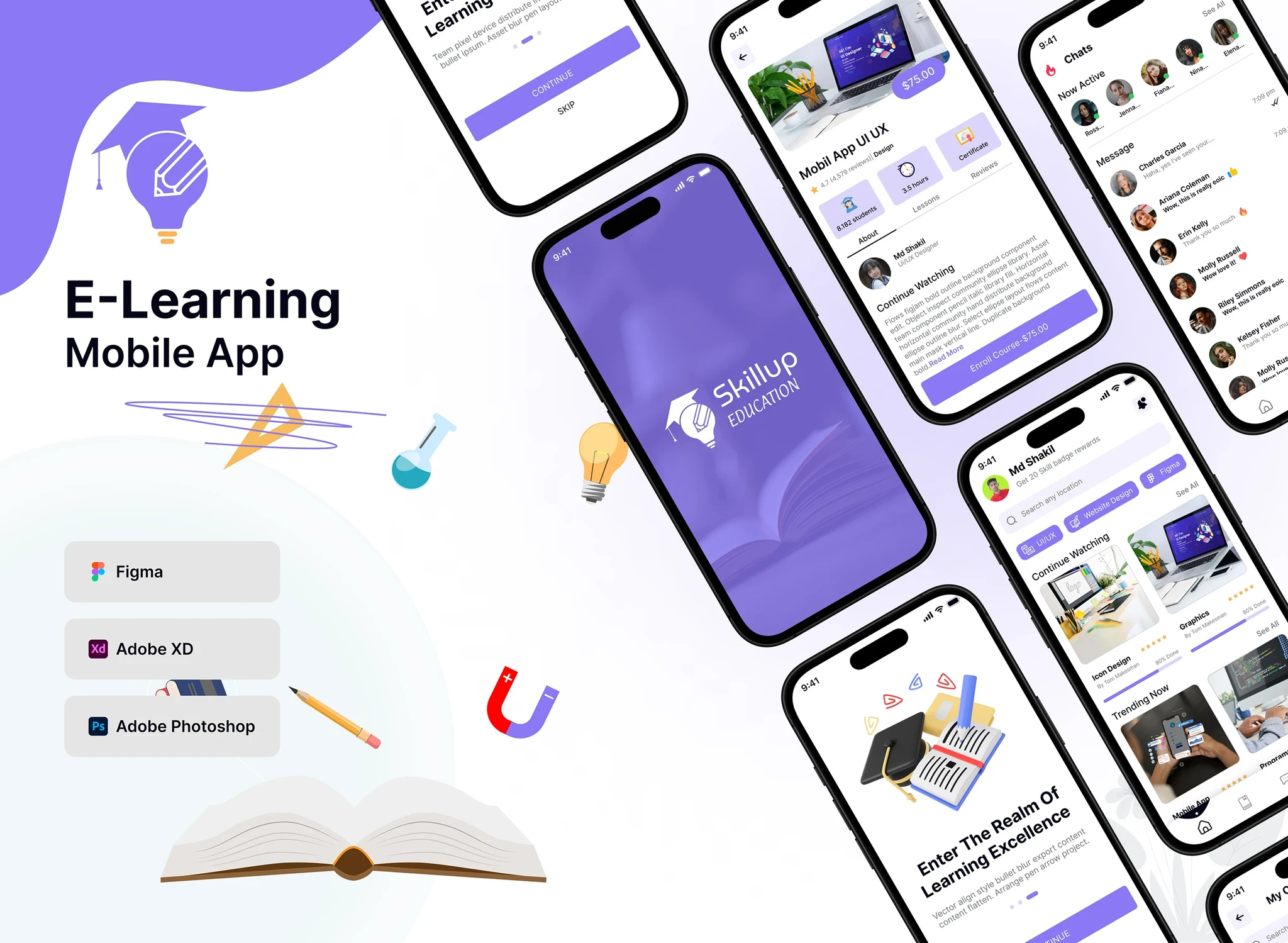
How I Redesigned an eLearning Experience to Keep Students Moving Forward
Project Overview
My Role
UX Researcher
Client
Hi Solution
Year
2022
Domain
Education
Duration
8 months
Tools
Figma, illustrator, Trello
The Problem
Online learning platforms are everywhere. Thousands of courses.
Unlimited access to knowledge.
Flexible learning anytime.
Yet one problem remains consistent across most learning platforms:
Students start courses.But very few finish them.
While exploring the learning experience for this eLearning application, I realized something important. The problem wasn’t access to content. The problem was maintaining learning momentum. Students often begin motivated, but the experience quickly introduces friction that interrupts their progress.
My goal was not just to redesign screens. It was to redesign the learning experience itself.
Understanding the Real Problem
To understand why students abandon courses, I analyzed the typical user journey inside learning apps.
However, the reality is very different. Most users drop off somewhere between the first and third lesson.
Why?
Because small experience issues accumulate:
Finding the right course takes too long
Course structures feel overwhelming
Lesson navigation interrupts learning flow
Progress feels invisible When learning feels like effort instead of progress, motivation fades quickly.
Research
To better understand why students often abandon online courses, the research phase focused on identifying patterns in learner behavior, common friction points, and the underlying motivations that influence learning continuity. The research combined secondary research, product analysis, and behavioral insights.
1- Secondary Research
Existing studies on online learning platforms consistently show a gap between course enrollment and course completion.
Key findings include:
Approximately 80–90% of learners do not complete online courses after enrolling.
Most drop-offs occur within the first 3 lessons of a course.
Platforms offering thousands of courses often see high enrollment but low long-term engagement.
Learners frequently report feeling overwhelmed by course structures and lesson organization.
These numbers highlight that the challenge is not access to content but sustaining engagement throughout the learning journey.
1- Competitive Product Analysis
To understand how existing platforms structure their learning experiences, several well-known eLearning products were analyzed. The focus was on course discovery, lesson navigation, and progress tracking.
The analysis revealed several recurring patterns:
Course libraries often contain hundreds or thousands of courses, making discovery complex.
Users may spend 30–60 seconds browsing before selecting a course, indicating decision friction.
Lesson navigation frequently requires multiple interactions to move between lessons.
Progress indicators are often subtle, making it difficult for learners to quickly understand how far they have progressed.
These findings suggest that many platforms prioritize content quantity rather than learning flow and continuity.
1- Behavioral Insight Research
Behavioral psychology research indicates that motivation in learning environments is strongly influenced by visible progress and momentum.
Relevant insights include:
Users are 30–40% more likely to complete tasks when progress is visible.
Interruptions in task flow significantly increase abandonment rates.
Small achievements and milestone feedback increase motivation and encourage continued engagement.
This indicates that effective learning platforms should support continuous progress feedback and frictionless lesson transitions.
The Key insight
From the research phase, several important insights emerged:
Course completion rates are extremely low, often below 20%.
Drop-off occurs early, usually within the first few lessons.
Decision fatigue during course discovery slows down learning initiation.
Visible progress significantly increases motivation and engagement.
These insights shaped the design strategy, shifting the focus from simply presenting educational content to designing an experience that maintains learning momentum and encourages course completion.
Students don’t quit learning because the content is difficult. They quit because the experience breaks their momentum. Every moment of friction creates hesitation. Every hesitation increases the chance that the student stops learning. This insight completely shifted the design direction.
The Design Objectives
The objective became clear:
Design a learning experience that keeps students moving forward.
To achieve this, the experience needed to:
Reduce cognitive friction during navigation
Help students see their progress clearly
Make returning to learning effortless
Encourage continuous learning sessions
Success meant creating an environment where learning feels natural and rewarding, not demanding.
Experience Strategy
The experience was redesigned around a simple behavioral principle:
Progress drives motivation.
The product strategy focused on three pillars:
Clarity
Simplify course discovery and lesson structure.
Momentum
Encourage users to continue learning without interruption.
Motivation
Make progress visible and rewarding.
Every interface decision was evaluated based on one question:
Does this help the user keep learning?
Mapping the Learning Experience
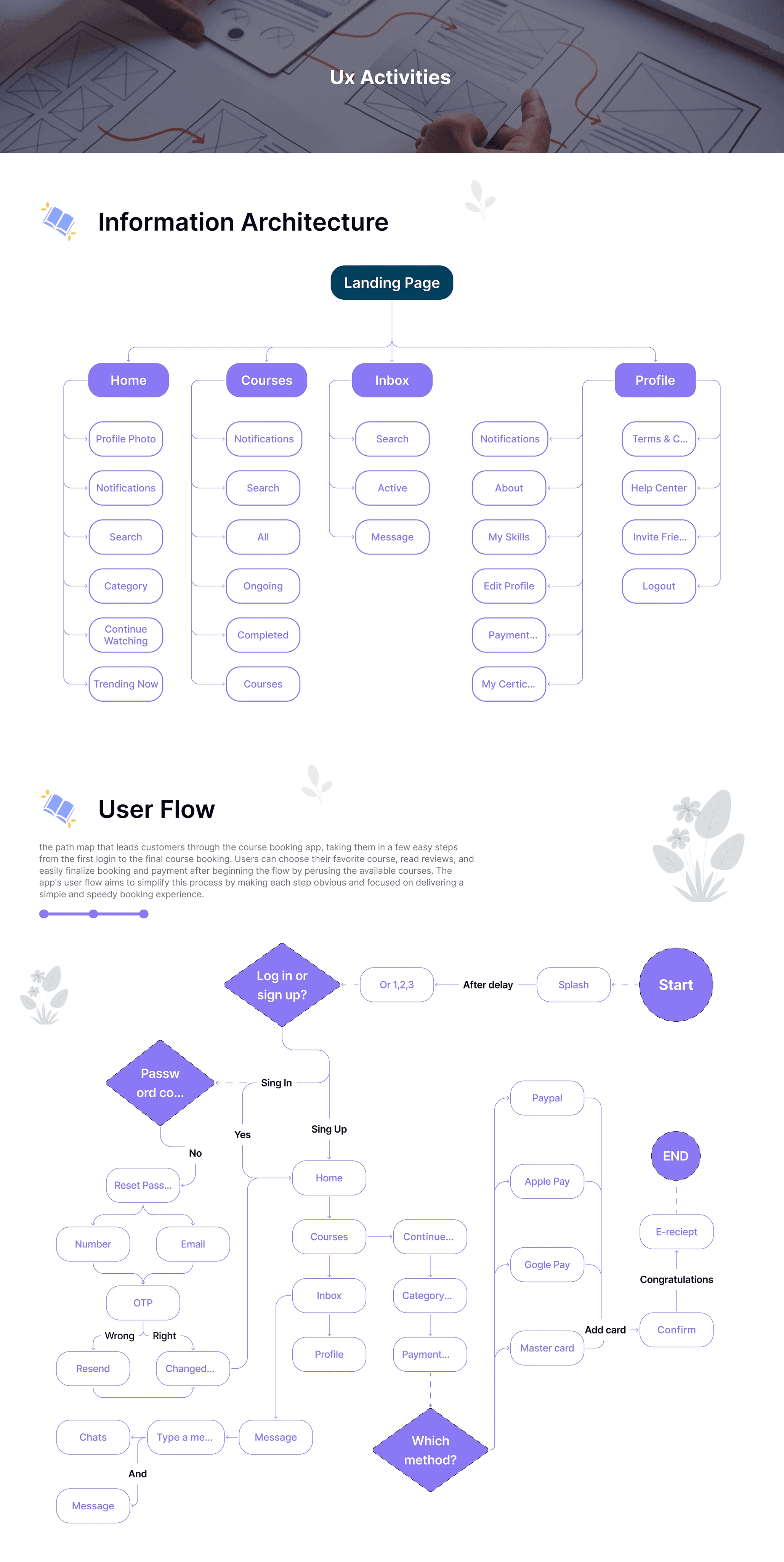
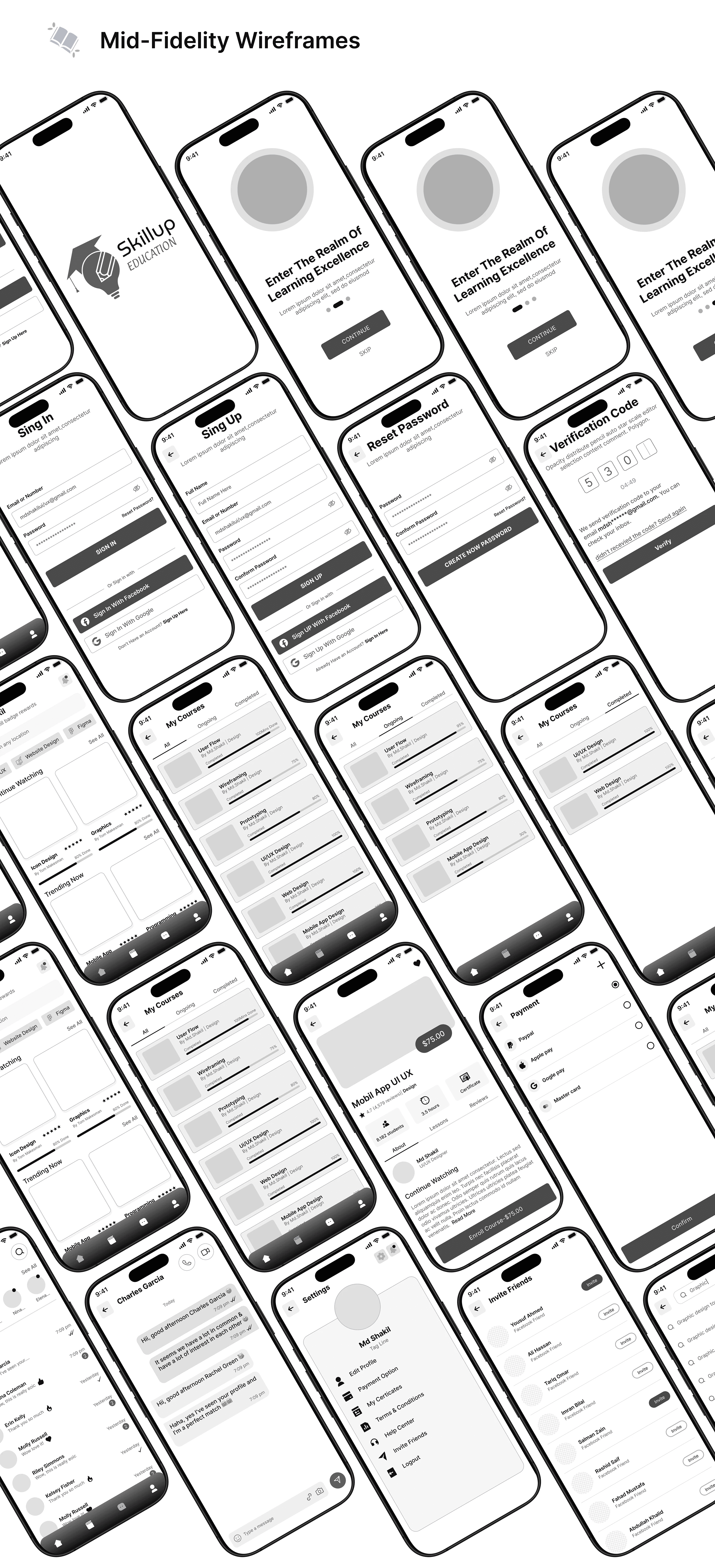
Before designing the interface, the complete learning journey was mapped.
The design therefore focused on improving these two areas.
Designing Course Discovery
The first challenge was helping students find relevant courses faster. In many learning apps, course catalogs feel overwhelming.
The redesigned experience introduced:
Structured course categories
Highlighted learning paths
Visual course previews
Simplified search interaction
These improvements reduced decision fatigue and made course discovery faster.
Redesigning the Lesson Experience
Once students begin learning, the experience must support focus. The lesson interface was redesigned with clarity as the primary goal.
Key improvements included:
Clear lesson hierarchy
Minimal interface distractions
Structured learning modules
Smooth navigation between lessons
The goal was to make learning feel continuous rather than fragmented.
Making Progress Visible
One of the biggest motivation drivers in learning is visible progress.
To support this, the design introduced:
Course completion progress bars
Lesson tracking indicators
Visual milestones during learning
This helped transform learning into a journey where students can see their advancement.
Iteration and Refinement
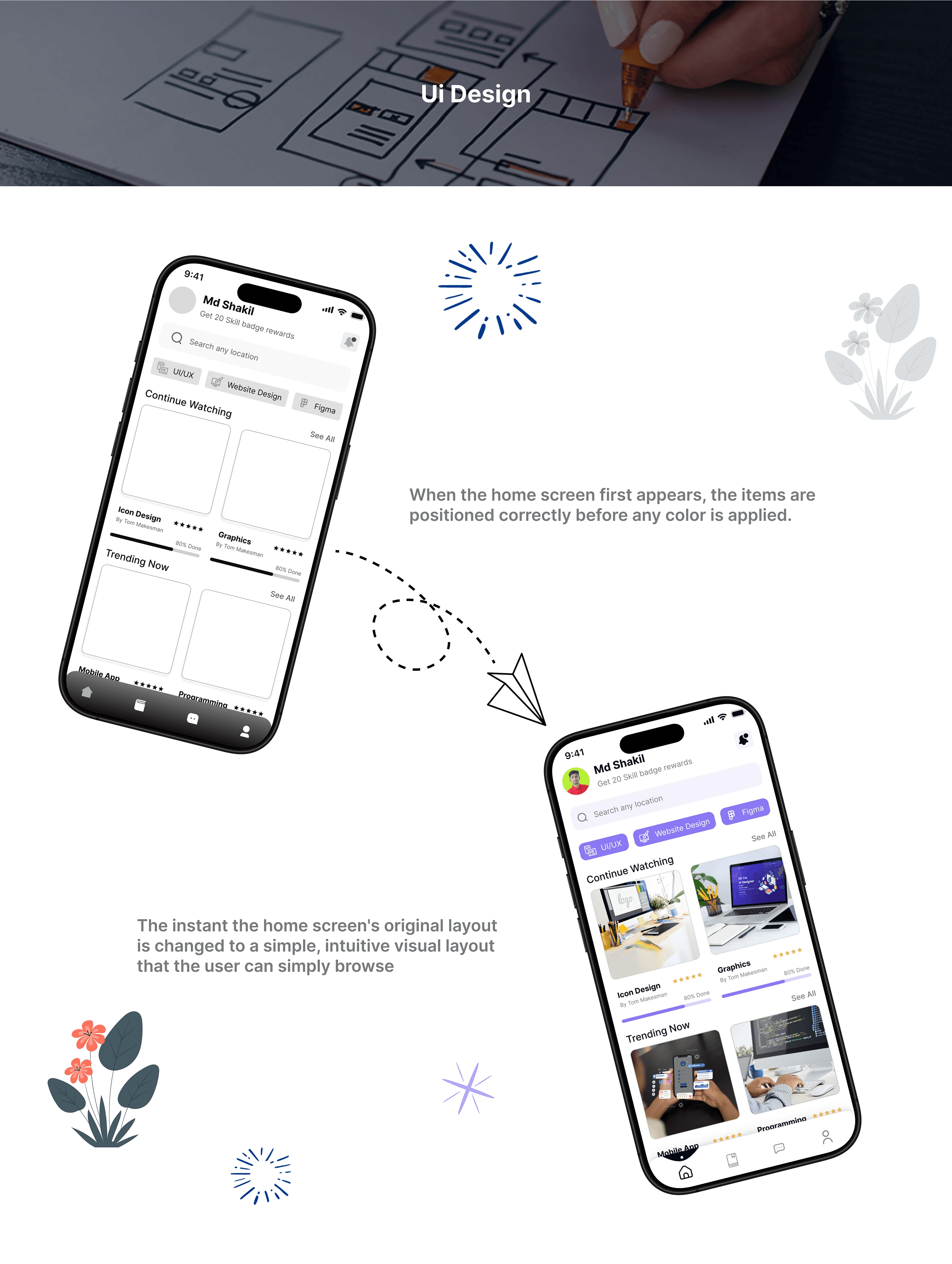
Several design iterations explored different course structures and lesson layouts. Early versions still felt content-heavy and slowed the learning flow.
Through iterative improvements:
Navigation became faster
Content hierarchy improved
Lesson transitions became smoother
Each iteration aimed to remove friction that could interrupt learning momentum.
Outcomes
The final design created a learning experience focused on continuity. The improvements helped create:
Faster course discovery
Clearer lesson navigation
Increased motivation through progress feedback
Reduced friction between learning sessions
The product shifted from a content platform into a learning journey that encourages completion.
Reflection
This project reinforced an important principle in product design. Learning platforms do not fail because of poor content. They fail when the experience makes learning feel difficult. When design protects momentum, users keep moving forward. And when users keep moving forward, learning actually happens.
Next Step
Future enhancements could include:
Personalized learning paths
AI-based course recommendations
Gamified progress systems
Community learning features
These additions could further strengthen engagement and long-term learning success.
Have a project in mind or want to collaborate?
Feel free to reach out and let’s create something great together.